


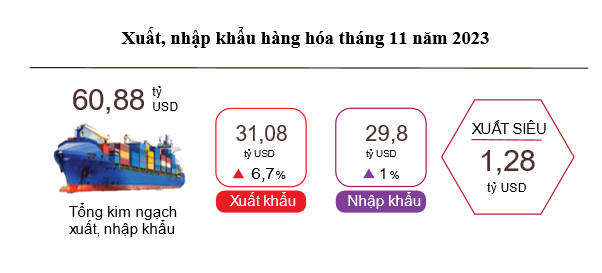
In November 2023, the total value of export and import goods was estimated at $60.88 billion, up 5.9% from the same period last year. In the first 11 months of 2023, the total value of export and import goods was estimated at $619.17 billion, down 8.3% from the same period last year. The trade balance of goods in November 2023 was estimated to be a surplus of $25.83 billion.
Exports gradually regain momentum
About merchandise exports, the estimated export value of merchandise in November 2023 reached US$31.08 billion, up 6.7% compared to the same period last year. Of which, the domestic economic sector reached US$8.49 billion, up 13.5%; the foreign-invested sector (including crude oil) reached US$22.59 billion, up 4.4%. This is a very positive highlight as the growth rate of domestic enterprises increased significantly, three times that of the foreign-invested sector.
In the first 11 months of 2023, the estimated export value of merchandise reached US$322.50 billion, down 5.9% compared to the same period last year. Of which, the domestic economic sector reached US$85.94 billion, down 2.2%, accounting for 26.6% of total export value; the foreign-invested sector (including crude oil) reached US$236.56 billion, down 7.1%, accounting for 73.4%. The export value, although still down compared to the same period last year, but the decline in export growth has narrowed significantly compared to the decline of 11.6% in the first 6 months of 2023.
33 items with export turnover of “billion dollars”
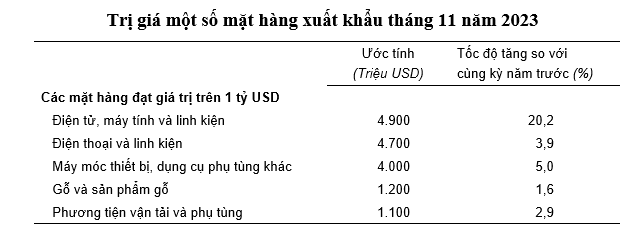
In the first 11 months of 2023, 33 items achieved export turnover of over 1 billion USD, accounting for 93.1% of the total export turnover (with 7 items exported over 10 billion USD, accounting for 66%). Many key export items have positive growth rates compared to the same period last year: Electronics, computers and components reached 4.9 billion USD, up 20.2%; Mobile phones and components reached 4.7 billion USD, up 3.9%; machinery, equipment, tools and spare parts reached 4 billion USD, up 5%; wood and wood products reached 1.2 billion USD, up 1.6%; means of transport and spare parts reached 1.1 billion USD, up 2.9%; seafood reached 800 million USD, up 1.4%; steel reached 586 million USD, up 25.4%.
Agricultural product export growth is impressive
In November 2023, agricultural products continued to make significant contributions, being a bright spot in the country's export activities, with many agricultural products increasing in both value and quantity compared to the previous month, such as:
- Rice reached US$462 million, up 13.5% (quantity increased by 10.2%);
- Rubber reached US$343 million, up 16.6% (quantity increased by 14.5%);
- Coffee reached US$252 million, up 59.9% (quantity increased by 83%);
- Cassava and cassava products reached US$151 million, up 10.6% (quantity increased by 11.8%);
- Pepper reached US$77 million, up 4.9% (quantity increased by 3.1%);
- Tea reached US$24 million, up 10.7% (quantity increased by 8.1%)."
However, in the first 11 months of 2023, only a few agricultural and aquatic products increased in both value and quantity compared to the same period in 2022, such as:
- Fruits and vegetables reached US$5.32 billion, up a robust 74.5%
In the first 11 months of 2023, Vietnam exported nearly 7.8 million tons of rice; 2.7 million tons of cassava and cassava products; 1.9 million tons of rubber; and 1.4 million tons of coffee.
Therefore, the export turnover of the agricultural and aquatic products group in November is estimated at 3 billion USD, up 26.7% from the same period last year. This is also the only group that recorded positive growth in the first 11 months of 2023, with export turnover estimated at 29.5 billion USD, up 8.6%.
Imports are gradually recovering.
Regarding imports, the estimated value of imports in November 2023 reached 29.8 billion USD, up 1% from the previous month. Of this, the domestic economic sector reached 10.6 billion USD, down 0.4%; the foreign-invested sector reached 19.2 billion USD, up 1.7%. Compared to the same period last year, the value of imports in November increased by 5.1%, of which the domestic economic sector increased by 4.2%; the foreign-invested sector increased by 5.6%.
However, in the first 11 months of 2023, the estimated value of imports reached 296.67 billion USD, down 10.7% from the same period last year, of which the domestic economic sector reached 105.94 billion USD, down 8.8%; the foreign-invested sector reached 190.73 billion USD, down 11.7%.
The import value of manufacturing materials continues to increase.
The structure of import items in the first 11 months of 2023 shows that the manufacturing materials group reached US$278.18 billion, accounting for 93.8%, of which the machinery, equipment, tools, and spare parts group accounted for 45.6%, and the raw materials, fuels, and materials group accounted for 48.2%. The consumer goods group reached US$18.49 billion, accounting for 6.2%.
One of the positive points in November was that the import value of manufacturing materials continued to increase from the previous month. Machinery, equipment, tools, and spare parts reached US$3.6 billion, up 0.9%; plastics reached US$1.1 billion, up 21.1%; chemical products reached US$750 million, up 15.9%; plastic products reached US$750 million, up 15.2%; chemicals reached US$700 million, up 2.4%; other common metals reached US$688 million, up 4.5%; textile, garment, footwear, and footwear raw materials reached US$650 million, up 30.9%; steel products reached US$650 million, up 30.4%; and rubber reached US$299 million, up 53%.
Compared to the same period last year, many items also saw an increase in value: Electronics, computers, and components increased by up to 40% (to reach US$7.9 billion); plastics increased by 13.6%; chemical products increased by 12.3%; plastic products increased by 13.9%; chemicals increased by 7.8%; textile, garment, footwear, and footwear raw materials increased by 30.7%; steel products increased by 28.9%; and rubber increased by 24.7%.
In the first 11 months of 2023, there were 43 imported items with a value of over 1 billion USD, accounting for 92.2% of the total import value (three imported items over 10 billion USD, accounting for 43.3%). Of these, electronics, computers, and components reached 79.2 billion USD, up 4.1%; pharmaceuticals reached 3.3 billion USD, up 7.3%; cashew nuts reached 3 billion USD, up 17.6%; electric wires and cables reached 2.3 billion USD, up 4.9%; products from other common metals reached 2.1 billion USD, up 11.1%; other petroleum products reached 1.6 billion USD, up 13.1%; glass and glass products reached 1.5 billion USD, up 4.9%; liquefied natural gas reached 1.5 billion USD, up 2.7%.
Due to imports falling more sharply than exports (exports fell by 5.9%, imports fell by 10.7%), Vietnam's trade balance continued to have a surplus of US$25.83 billion in the first 11 months (compared to US$10.3 billion in the same period last year). Of this, the surplus was attributed to the foreign-invested sector (including crude oil) with a surplus of US$45.82 billion; the domestic economy had a trade deficit of US$19.99 billion.
Expanding the market, strengthening trade alerts
In terms of export and import markets in the first 11 months of 2023, the United States is Vietnam's largest export market with an estimated value of US$88 billion. China is Vietnam's largest import market with an estimated value of US$99.6 billion. In the first 11 months of 2023, the export surplus to the United States was estimated at US$75.5 billion, down 14.1% from the same period last year; the export surplus to the EU was estimated at US$26.2 billion, down 11.1%; the export surplus to Japan was estimated at US$1.5 billion, up 127.2%; the import surplus from China was estimated at US$43.7 billion, down 23.1%; the import surplus from South Korea was estimated at US$26.3 billion, down 25.4%; the import surplus from ASEAN was estimated at US$8.1 billion, down 31.3%.
In the context of low global economic growth, weak global consumer demand, rising protectionist barriers, and continued monetary tightening in many countries, the export and import situation in the last month of the year will face many difficulties. In addition, major economies that are Vietnam's export partners, such as the United States and the European Union, are reducing their spending on ordinary and luxury goods, which is causing a decline in order volume. Meanwhile, domestic industrial production sectors mainly focus on exports, with a heavy reliance on the global market, as domestic production output far exceeds domestic market demand. For example, industries such as textiles, leather and footwear, and electronics only supply 10% of their output to domestic demand, with the remaining 90% being exported.
The reopening of China also creates much competitive pressure for Vietnamese exports of the same type. Meanwhile, Vietnamese businesses are still facing many difficulties due to declining foreign orders, weak domestic market demand, high input costs, and difficulty in accessing credit.
To reduce the above difficulties for exporting enterprises, the Ministry of Industry and Trade will accelerate the negotiation and signing of new trade agreements, commitments, and linkages, including completing the implementation of the FTA with Israel, signing FTAs, trade agreements with other partners with great potential (UAE, MERCOSUR ...) to diversify markets, products, and supply chains.
At the same time, support businesses to take advantage of the commitments in the FTAs, especially the CPTPP, EVFTA, and UKVFTA, to boost exports, through the dissemination of information on rules of origin and the issuance of certificates of origin, opportunities, and how to take advantage of opportunities from the agreements.
The Ministry of Industry and Trade is also coordinating with the Ministry of Agriculture and Rural Development to negotiate with China to open up additional export markets for other Vietnamese fruit and vegetable products, such as green pomelo, fresh coconut, avocado, pineapple, custard apple, lemon, and watermelon. It will also improve the efficiency and regulate the speed of customs clearance for import and export goods at border gates in the border area between Vietnam and China, especially for seasonal agricultural and aquatic products; quickly and strongly switch to official export.
In addition, strengthen early warning of trade defense cases; guide businesses on how to respond to cases; promptly inform businesses and associations about market needs, new regulations, etc.
According to the website of the General Statistics Office of Vietnam.